Products · Haldwani, Uttarakhand

The lines we work with, and how one is chosen for you

Professional product is bought one item at a time, for what it does on real hair and a real face rather than for the name on it. This page explains how those choices are made — and why the answer for you is decided at the chair rather than on a page.

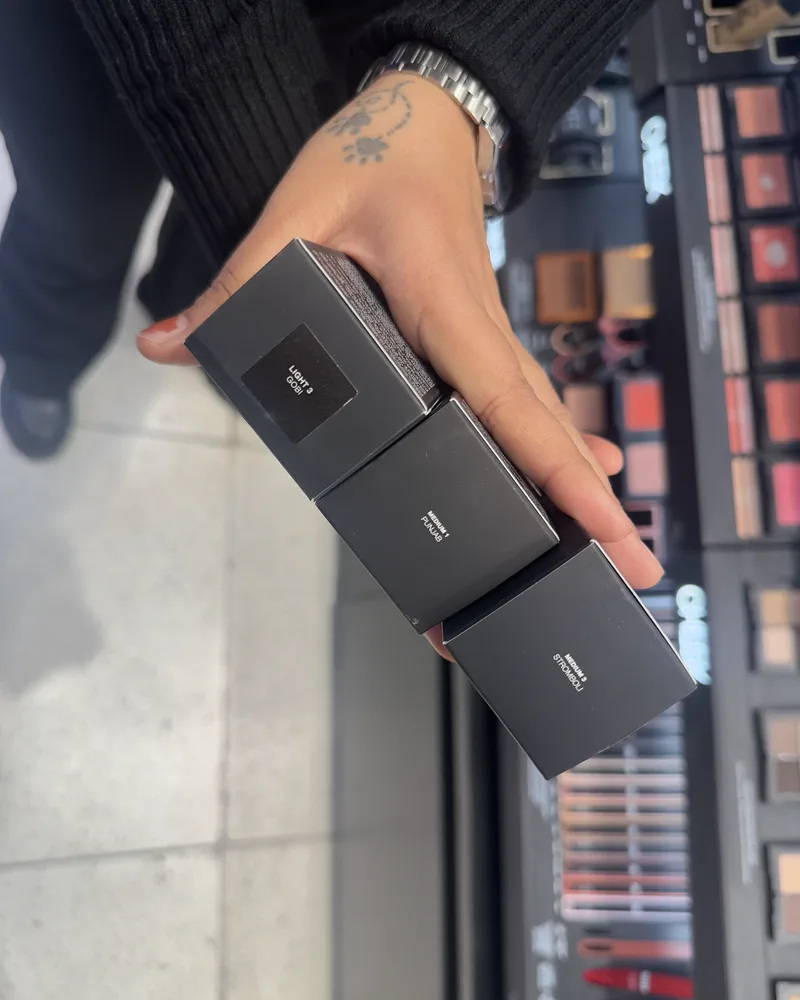
Professional makeup products held above the makeup counter at Salon By Babita, Haldwani

Products are a standard here, not a selling point

Nothing is kept in this kit because it is fashionable or because it sells well. A line earns its place by behaving predictably — on Indian skin, in Kumaon heat, through a full wedding day, under a photographer's light.

Babita buys professional stock from professional supply, and every product in use has a name she will give you if you ask. Counterfeit and diverted stock are a real problem in this category and are rarely spoken about; the answer is dull and it works — known suppliers, sealed product, and nothing decanted into an unlabelled pot.

A brand name is information, not an argument. The line matters far less than whether the shade, formula and finish are right for the face in front of us, which is why the page below spends more words on how a product is chosen than on who makes it.

Nothing reaches a guest before it has been through the same route. A demo first, where the application and the limits are gone through — what it is for, and what it should not be put on. Then Babita uses it herself, on her own hair or skin, and reads the texture and the result over time rather than on the day. Only once she is confident in it does it go on a guest, and feedback is taken afterwards. A product she is not confident in does not enter this salon, whatever it costs and whoever makes it.

No brand is perfect at everything, and none is treated as though it were. Confidence is built product by product rather than granted to a logo. What is refused is refused on the same basis: a cheap line with no proper ingredient list, and anything carrying a salon-quality label that is really a duplicate. Those are not a matter of taste — they are how allergies, damaged hair and a disappointed guest happen, and the work stops being worth doing.

Home care is sold here, and the line between what is sold and what is not is a fixed one. Six things go home with a guest: shampoo, conditioner, serum, sunscreen, cleanser and moisturiser. Professional stock does not. Developer, bleach, salon-only peels and acids, and professional colour stay in the salon and are neither sold nor handed over, whatever they are wanted for — those are products that need a trained hand and a diagnosis behind them, and at home they do damage rather than good.

Two limits sit on that. You leave with three items at most, because a routine longer than that is one nobody keeps and the products stop being used properly. And the brand is named to you rather than described as a category — you should know what is going on your hair and your skin, and there is no reason to keep it from you. What is not on this page is a price: the honest figure depends on what you are actually given, and it is quoted at the counter rather than published here.

  • Professional stock, sealed

    Bought from professional supply, kept in its own packaging, never decanted unlabelled.

  • Named on request

    Ask what is being used on you at any point and you will be told the product, not the category.

  • Selected one product at a time

    A line is kept for specific products that perform, not adopted wholesale as a range.

  • Home care is sold; professional stock never is

    Shampoo, conditioner, serum, sunscreen, cleanser, moisturiser — three at most. Developer, bleach and professional colour do not leave the salon.

  • Opened-life or printed expiry, whichever comes first

    The opening date goes on the container at first use, and the earlier of the two dates is the one that ends it.

  • Demo, then her own head, then yours

    Babita uses a product on herself before any guest sees it. No confidence, no place in the kit.

Why professional products matter

Professional lines are built for a different job than most retail makeup: they are applied by someone trained, worn for twelve hours or more, and photographed under light that finds every weakness in a base.

That shows up in specifics rather than slogans — pigment that holds its colour instead of shifting as the day warms, a base that does not flash white in a camera flash, a formula that lifts cleanly at the end of the night, and shade ranges deep enough that a match is chosen rather than approximated.

It also shows up in hygiene, which is where professional practice differs most from a home routine. Product comes off with a spatula rather than fingers, brushes are cleaned between guests, and anything that touches the eye or lip area is handled as single-use where it should be.

Four things mark a product as genuinely professional rather than professionally packaged: a full, readable ingredient list; proper testing behind it; distribution through salon supply rather than a shelf; and training issued with it, including the things it must not be used on. What makes one unsafe is the mirror of that — an incomplete list, an undeclared steroid or a strong acid hidden inside it, or a container arriving with no batch number and no expiry date. Those three are enough on their own; the brand name is not part of the test.

One thing outranks the product itself. A flat iron with real temperature control does more for hair than any bottle in the room, because a poor iron will ruin a good product on any head — which is why the tool is bought to the same standard as what goes on the shelf.

Stock is checked before it is accepted, not after something goes wrong with it. Professional lines are bought from authorised distributors or the brand's own channel and never from a general market or an online marketplace. Five things are read on the packaging as it arrives: the batch number, the manufacturing and expiry dates, an intact seal, the authenticity sticker, and the importer's details. A seal that is broken or has been tampered with is not opened at all — that batch goes back. A batch that looks or smells different from the last one is set aside and verified with the supplier against its batch number before it touches anybody. The invoice and the batch number are both kept.

Once a container is open it is on a clock. Everything is kept cool, dry, out of direct sun and properly closed, with the date it was opened written on it — heat and humidity are what spoil product in this region, and stock left near a window goes first. Two dates then govern it: the life it has once opened, which is six to twelve months for most products or whatever the maker states, and three to six months for chemical stock and developer; and the expiry printed on the container. Whichever of the two falls first is the one that ends it, and it ends whether or not the product still looks usable. Colour or smell that has shifted, a texture that has separated, or a container that has swollen takes it out of use before either date does.

  • A full, readable ingredient list — not a marketing panel
  • Proper testing behind the formula, and salon-only distribution
  • Training supplied with it, including what it must not go on
  • Batch number and expiry on the container, every time
  • No undeclared steroid and no hidden strong acid
  • Pigment and wear tested over a full day, not a photograph
  • Shade ranges deep enough to match Indian skin tones properly
  • Behaviour under flash and video light known in advance
  • Formulas chosen for humidity and heat, not for a swatch
  • Decanting, spatulas and brush hygiene handled as routine
  • Ingredients checkable when a guest has a sensitivity or is pregnant
  • Bought from an authorised distributor, never a general market
  • Seal intact on arrival — a broken one goes back unopened
  • Opening date written on the container at first use
  • Product taken out on a spatula, and never put back in

What actually decides the product used on you

The line is the last decision, not the first. Five things are read before a product is picked up, and any one of them can rule a favourite out.

  • Skin type

    Oily, dry, combination or sensitive — the base and its primer change entirely with the answer.

  • Hair condition

    Where hair work is involved, porosity and previous chemical work decide what may be used on it.

  • The treatment itself

    A trial, a wedding morning and a party look are three different jobs and rarely use the same products.

  • The finish you want

    Matte, satin or dewy, and how it must read in photographs — you say it, and the shortlist narrows.

  • The consultation

    Sensitivities, allergies, what you already wear and what has failed on you before are asked first.

  • Whether lines may be mixed

    Across different jobs, yes. Inside one chemical system, never — it is a single brand end to end.

  • Never the price tag

    An expensive product on the wrong skin damages it exactly as much as a cheap one would.

  • A cream you brought yourself

    A doctor's prescription, or your own cream for sensitive skin, may be used — after Babita has read its ingredients.

No guest receives every brand on this page, and no brand is used on every guest. What is kept in the kit is a shortlist to choose from — the choice itself is made for your condition, your treatment and the finish you asked for, never for the name on the tube or what it cost, and it is explained to you at the time. The product is named at the end of the consultation rather than at the start of it: the reading comes first, and where the reading turns up an allergy the shortlist changes whatever the service is. Where a product has to be swapped because something is unavailable, that decision is Babita's rather than the stylist's — and inside a chemical service nothing is swapped at all once the work has started.

The lines kept in the kit

The hair line is listed first because it is the one that decides a chemical service. Colour and makeup lines follow. Skin lines are added to this page as they are confirmed.

Hair

Schwarzkopf

A professional hair house whose colour, smoothing and care ranges are distributed through salon supply rather than retail.

Typically used for

  • Colour and root work, where the shade has to land predictably
  • Smoothing systems run as a complete system rather than assembled
  • Salon care and conditioning work between chemical services

Why it is kept

It is the hair line Babita trusts furthest, and the reason is consistency rather than prestige: across most of the hair categories worked here it gives the same result on the same reading, which is what lets a plan be promised before it is done. It earned that the ordinary way — demo, then her own hair, then guests, then their feedback.

Where it may be used

  • Hair colour and root touch-ups
  • Keratin and smoothing services
  • Hair spa and conditioning courses

Read how a hair treatment is decided

Colour and makeup

MAC

A professional colour house that has worked backstage and in studios for decades, known for a broad shade range and formulas built for long wear.

Typically used for

  • Long-wear base on a full wedding day
  • Shade matching across deeper and warmer tones
  • Strong lip colour that has to survive a ceremony

Why it is kept

It is the line Babita reaches for when a look has to hold for twelve hours and be photographed at the end of them — the wear is predictable, and the shade range is deep enough to match rather than approximate.

Where it may be used

  • Bridal and wedding-day makeup
  • Engagement, reception and party looks

Read how bridal makeup is planned

Colour and makeup

NARS

A colour line with a photographic heritage, built around pigment strength and skin-like base textures.

Typically used for

  • Blush and contour that read on camera without going heavy
  • Bases where the skin must still look like skin
  • Eye colour that stays true through the evening

Why it is kept

Chosen for pigment that behaves in photographs: the colour that goes on is the colour that comes back in the picture, which matters most on the faces that will be photographed all day.

Where it may be used

  • Bridal trials, where the look is settled in advance
  • Photography and event makeup

Colour and makeup

Tarte

Known for high-coverage, long-wear complexion products with a comfortable finish.

Typically used for

  • Coverage where a guest asks for evenness rather than a mask
  • Humid days, where a base has to stay put
  • Cream products that can be layered without turning heavy

Why it is kept

Kept for guests who want real coverage but dislike the weight that usually comes with it — it holds through heat while still moving with the face.

Where it may be used

  • Party and occasion makeup
  • Pre-wedding functions in warm weather

Colour and makeup

Dior Beauty

A luxury house whose complexion and lip products are known for a refined, light-handed finish.

Typically used for

  • Soft, luminous bases for a bride who does not want a heavy face
  • Finishing touches where texture matters more than coverage
  • Lip and cheek colour with a quiet finish

Why it is kept

Used where the brief is restraint — the guest who wants to look like herself at her best, with the makeup noticeable only as a result and not as a layer.

Where it may be used

  • Bridal looks with a natural, understated brief
  • Engagement and reception makeup

Read how bridal makeup is planned

Colour and makeup

Burberry Beauty

A smaller luxury colour range, tightly edited, leaning towards neutral and muted tones.

Typically used for

  • Understated day looks and daytime functions
  • Neutral eye and lip palettes for a soft finish
  • Looks built around an outfit rather than around colour

Why it is kept

Kept for the muted end of the range, where a strong colour would fight the outfit — a small edit, used deliberately rather than often.

Where it may be used

  • Daytime ceremonies and haldi or mehendi functions
  • Soft party and occasion looks

Want to know what would be used on your skin?

Tell us the occasion, your skin type and the finish you have in mind. You will get a straight answer about what would suit you — including when the honest answer is something simpler than you expected.

Six questions, then a conversation

What are you considering?

Choose the closest one. If something else would suit you better, Babita will say so.

Is there an occasion?

This decides how much time the work needs, and how far ahead to start.

An approximate date is enough at this stage.

Preferred time

We will tell you what is genuinely free that day.

Call the salon

Your answers become a WhatsApp message you can read, edit and send yourself. Nothing is stored on this website, and no one is added to a mailing list.