Hair · Haldwani, Uttarakhand

Keratin, for hair that behaves until the humidity arrives

A sealing treatment that stops frizz lifting and takes the fight out of a blow-dry, without making your hair permanently straight. Whether your ends can hold it is decided by reading the hair, not by the length of the appointment.

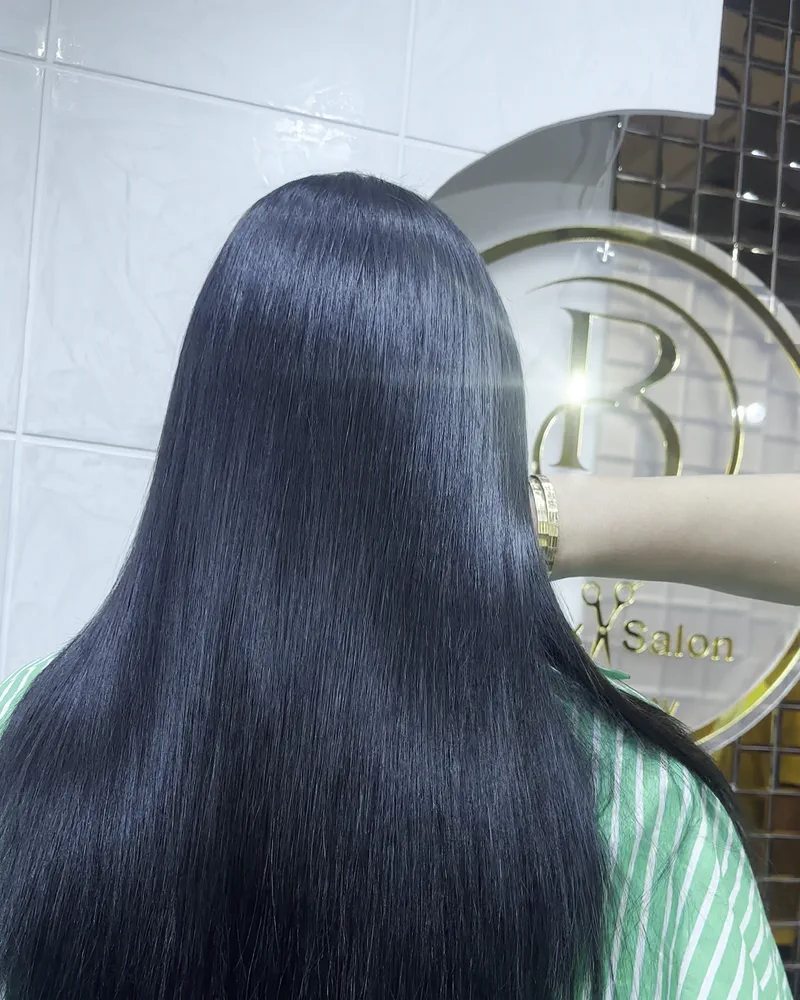
Long black hair brushed straight to a glossy finish, seen from behind at Salon By Babita, Haldwani

What keratin is for

Keratin is the protein hair is largely made of, and a keratin treatment puts a professional formulation of it onto and into the outer layer of the shaft, then sets it there with heat. The cuticle lies down, the surface becomes even, and hair that used to swell and lift in damp air stays where it was dried.

The job it does is behavioural. Drying time drops, the brush moves through without catching, flyaways stop rising at the crown, and hair that took forty minutes and two tools most mornings starts taking half of that with one. The shape of your hair is not rewritten — curls and waves are still curls and waves, softer and better defined, and they come back fully as the treatment wears away.

That is what separates it from the chemical services further along this hub. Smoothening and rebonding alter the hair's internal bonds and leave a regrowth line; keratin does neither. It sits on and just inside the cuticle, fades evenly, and leaves nothing to grow out — which also means it does not last as long, and it is not sold as though it does.

Formulations differ more than the word suggests. Protein weight, sealing strength and the iron temperature a line is designed for all change what should be opened for your hair, and the lines kept here are chosen against your hair's condition rather than because a treatment was booked under one name.

  • Works at the cuticle

    The hair's internal bonds are left alone — nothing is broken and nothing is reformed.

  • Frizz managed, wave kept

    Pattern is softened and defined rather than removed; it returns intact as the treatment fades.

  • No regrowth line

    It fades evenly across the length, so there is no border where treated hair meets new growth.

  • Two to four hours in the chair

    Decided by length, density and how much sealing the hair needs — confirmed once it is seen.

Who keratin suits, and who it does not

Most disappointment with keratin comes from booking it for a job it was never meant to do. Suitability is settled before anything is opened.

This is for you if

  • Hair in reasonable condition that turns frizzy the moment the weather changes, and behaves the rest of the time.
  • Thick or coarse hair that dries slowly and needs a lot of tool time every morning.
  • Waves and loose curls you want defined and calm, not removed.
  • Hair with light or well-managed colour, where the ends are still elastic rather than fragile.
  • Anyone willing to change to a sulphate-free, salt-free shampoo — the treatment depends on it.
  • Guests who want a lower-commitment option than a structural straightening service.

This is not for you if

  • Anyone expecting poker-straight hair that stays straight after washing. Keratin makes straightening easy; it does not perform it.
  • Highly bleached or heavily lightened hair with porous, chalky ends — sealing fragile hair traps damage rather than repairing it.
  • Hair that snaps when stretched wet. Elasticity has to come back first, and that is a repair plan, not a smoothing appointment.
  • Anyone who cannot or will not change shampoo. Ordinary shampoo will strip it inside weeks, and paying for that is not worth doing.
  • An itching, flaking or broken scalp. That is settled with a doctor first, and the appointment waits.
  • Anyone pregnant or breastfeeding who has not spoken to their doctor. Tell us, and the plan is built around what they allow.
  • Hair that has had a strong chemical service very recently, where the right answer is a gap rather than another process.

Our professional assessment

This treatment genuinely changes the hair's texture, and it sets with heat. Both facts point the assessment at one question: how much the fibre can still take.

That is answered with a single wet strand. Taken between the fingers and stretched gently, hair in good order gives a little and springs back. Damaged hair does one of two things — it breaks at once, or it stretches and simply stays there, refusing to return. Hair that stays stretched is hair that will not tolerate the heat this service needs, and the answer at that point is no. Losing a booking is the lesser cost.

Where the reading is favourable, it also predicts how long the result will last. Of everything kept here, this treatment holds longest on thick, coarse hair — so density and texture are read as part of the same examination, and what you are told about longevity comes from your own hair rather than from the brochure.

Elasticity is the other half of that prediction, and it works in both directions. Hair thick and frizzy enough to look like a modest result on paper can hold one far longer than expected when the strand springs back strongly — the longest results seen here have come from exactly that combination, and what those guests report is not the mirror but the hour a morning they stopped spending on it.

  • One wet strand decides it

    Healthy hair gives and returns; damaged hair snaps, or stretches and stays stretched.

  • The texture is genuinely altered

    This is not conditioning with a smoothing effect — the hair is straightened, and read accordingly.

  • Heat is the limiting factor

    The service runs hot, so tolerance of heat — not the look you want — sets eligibility.

  • Thick, coarse hair holds it longest

    Density and texture are read to give you a realistic answer on how long it will last.

What is read before it is booked

Keratin is booked only after the hair has been examined, because two heads that look identical dry can take the same formulation very differently once it is on.

Porosity and elasticity are checked by hand on wet and dry hair; the ends get most of the attention, since they are the oldest hair on your head and the part that decides whether sealing helps or hides a problem. Your chemical history is taken in full, and henna in particular is asked about directly — it changes what may safely be used and it is not always visible.

Where henna is in that history, a strand test is not optional and it is not a formality. The piece is processed exactly as the full service would be, and what it does decides the appointment: a strand that comes apart in the hand ends it there, and what you are given instead is a repair plan. That answer has been given to guests who arrived specifically for this treatment, and it is the answer they would have wanted an hour later.

Then your routine is discussed honestly, because it is half of the outcome. How often you wash, what your water is like, whether you swim, and whether you are willing to change shampoo all move the answer. If the routine will not support the treatment, that is said before it is booked — the treatment is not the part that fails in those cases.

  • Porosity and elasticity, checked wet and dry
  • The condition of the ends, and whether a cut should come first
  • Full chemical history, henna included, for the last year
  • Any previous smoothing or straightening, and how long ago
  • Scalp condition and sensitivity
  • Wash frequency, water hardness and current shampoo
  • Swimming, sun exposure and daily heat styling

How the appointment runs

One sitting, six stages, and two of them can end it. Timings are typical for medium-length hair and are confirmed once yours has been seen.

  1. Assessment and strand test

    15–20 minutes

    The hair is read, the history taken, and a strand test run where colour or previous chemical work makes the outcome uncertain. The formulation and the iron temperature are chosen from what that test shows.

  2. Clarifying wash

    20–25 minutes

    Two cleanses, sometimes three on hard-water hair, to lift mineral deposit, silicone and oil. Keratin cannot bond to a coated cuticle, and skipping this is how a treatment turns patchy at week two.

  3. The basin check, and the point it can stop

    Part of the wash

    Wet hair reads differently from dry, so it is felt again at the basin. Hair that turns soft and gummy there is carrying damage the history did not mention, and the appointment stops at that point rather than continuing carefully — the sealing pass runs hot, and that heat on a weakened shaft is what breaks hair along its mid-length instead of smoothing it. A repair treatment takes the slot instead, and the smoothing plan is rebuilt from what the hair actually showed.

  4. Application in fine sections

    40–60 minutes

    Applied section by section from mid-length to end, kept off the scalp, and combed through so saturation is even. Roots take less than ends because they need less; that judgement is made strand by strand rather than by rule.

  5. Drying and sealing

    45–90 minutes

    The hair is dried fully, then passed with the iron at the temperature the formulation and your hair's condition allow — the lowest that will set it, in as many passes as it genuinely needs. Three things stop a pass immediately rather than at the end of the section: a burning smell, visible smoke, or hair catching on the plates. None of them is a stage the treatment goes through.

  6. Result and home routine

    10 minutes

    You see the hair down and unstyled, and you leave knowing the wait before the first wash, the shampoo to switch to, and the two or three habits that will shorten the result if they stay.

What changes, and for how long

Hair that dries smoother and quicker, sits flatter at the crown, and stops reacting to damp air. Most guests notice the morning routine before they notice the mirror — the tools come out less and the brush stops catching.

The wave underneath is softened, not removed. If you air-dry, you will see a looser, more organised version of your own pattern rather than a straight result, and that is the treatment working as intended. Straight hair, if you want it, is a blow-dry that now takes a fraction of the effort.

How long it holds is decided almost entirely after you leave. Wash frequency, water hardness, sulphates, salt water and chlorine each shorten it; a sulphate-free routine and cooler water extend it. It is described as a range of weeks to a few months because that is the honest span, and it fades gradually rather than ending on a date.

  • Less tool time every morning

    The change guests report first — drying is faster and needs fewer passes to look finished.

  • Holds in damp weather

    The cuticle stays flat instead of swelling, which is where frizz starts in the first place.

  • Lifespan follows the routine

    Shampoo type, wash frequency and water do more to it than anything done in the chair.

  • Fades evenly, with no line

    Your own texture returns gradually across the length rather than at a visible border.

Protecting the result

Keratin is unusually sensitive to what happens at home in the first fortnight. These are the instructions you leave with.

  • Leave the hair unwashed, untied and unclipped for the period you are given — a pressed kink set in that window can stay set.
  • Switch to a sulphate-free, salt-free shampoo before your first wash, not after you notice the fading.
  • Wash in cooler water and less often. Hard water shortens keratin faster than heat does, so a filter earns its cost here.
  • Rinse thoroughly after swimming; chlorine and salt strip a sealed cuticle quickly.
  • Keep a heat protectant in the routine. The treatment reduces how much heat you need, it does not make heat harmless.
  • Plan colour around it rather than onto it — the gap between the two services is agreed at the consultation.
  • Tell us how it wore before your next booking. Hair that lost it at week three changes what is used next time.

Looking after hair at home

Products selected for hair like yours

Professional lines chosen against porosity, protein weight and how much sealing the hair will tolerate. No guest receives every line, and you may ask what is on your hair at any point.

  • The hair line kept furthest forward

    Chosen for consistency rather than prestige, and run as a complete system inside any chemical service.

    Schwarzkopf · Professional colour, smoothing and care ranges

    Across most of the hair work done here it gives the same result on the same reading, which is what allows a plan to be agreed before it is started. Inside a chemical service the cream, developer and neutraliser all come from this one system — combining lines mid-process is what makes a reaction unpredictable.

Keratin questions

The questions asked at the chair, answered here instead. Anything not covered is worth a message — an answer without a booking attached is still an answer.

Is a keratin treatment permanent?

No, and it is not designed to be. It is a coating and sealing treatment that fades gradually over weeks to a few months, leaving your own texture behind exactly as it was. Because it does not alter the hair's internal bonds, there is no regrowth line and no point at which it has to be corrected — when it has worn off, you simply decide whether to repeat it.

When can I wash my hair afterwards?

You will be given an exact wait at the chair, because it depends on the formulation used on you. Whatever the number, treat that window seriously: leave the hair loose, avoid clips, bands and tucking it behind your ears, and do not tie it up to sleep. A kink pressed in during that period can set, and correcting it means heat the hair did not need.

Do I really have to change my shampoo?

Yes — this is the single condition the treatment depends on. Sulphates and sodium chloride strip the seal, and an ordinary shampoo can take weeks off the result in a handful of washes. If switching is not something you want to do, that is a good reason not to book the treatment, and we would rather say so beforehand than take the appointment.

Can it be done on coloured hair, and in what order?

Usually yes, and the order matters. Colour is generally done first, with a gap before the keratin, since the sealing step can lift a fresh tone slightly and colour applied afterwards behaves unpredictably on a sealed cuticle. Heavily bleached hair is a different conversation: if the ends are porous and fragile, sealing them is not the treatment they need. The plan and the gap are agreed at the consultation rather than improvised on the day.

I have curly hair. Will keratin take my curls away?

It loosens and organises them rather than removing them. Expect a softer, more defined pattern, much less frizz between the curls, and far less resistance if you choose to blow-dry it straight. Your curl returns as the treatment fades. If the goal is to be rid of the curl rather than to manage it, keratin is the wrong booking and a structural service should be discussed instead — with its own trade-offs stated first.

What about formaldehyde?

The lines kept here are chosen as formaldehyde-free, and you are welcome to ask which product is being used and to see the packaging before it is opened. The answer you get is the product name, not the category. Ventilation and technique still matter with any sealing treatment, and the salon works accordingly.

How soon can it be repeated?

When the previous treatment has genuinely worn off, which for most guests is a few months rather than a fixed schedule. Re-sealing hair that is still sealed adds weight without adding benefit, and on finer hair that reads as limp. The hair is reassessed at each visit and repeating is sometimes declined for exactly that reason.

Will it make fine hair look flat?

It can, if the wrong formulation is used or if it is applied too close to the root. Fine hair is assessed carefully for that reason: a lighter product, less of it, and application kept well away from the scalp usually gives the frizz control without the collapse. Where fine hair is also limp to begin with, the honest recommendation may be conditioning work instead, and you will be told that before you book.

Before you decide

Read the comparison, look at the work, then message with your hair described in your own words.

Describe your frizz, and when it happens

Tell us what your hair does on a humid day, what colour it has had, and how you dry it. You will get a straight answer about whether keratin is the right treatment, what it will change, and when it is worth waiting instead.

Six questions, then a conversation

What are you considering?

Choose the closest one. If something else would suit you better, Babita will say so.

Is there an occasion?

This decides how much time the work needs, and how far ahead to start.

An approximate date is enough at this stage.

Preferred time

We will tell you what is genuinely free that day.

Call the salon

Your answers become a WhatsApp message you can read, edit and send yourself. Nothing is stored on this website, and no one is added to a mailing list.