Luxury nails · Haldwani, Uttarakhand

Nail extensions, built on what your nail can carry

Gel, acrylic or an overlay — the choice is made from the state of your own nail plate and the way you use your hands, not from a photograph. Prep and sanitisation come first, the refill is planned in at two to three weeks, and a nail that is not ready is not worked on.

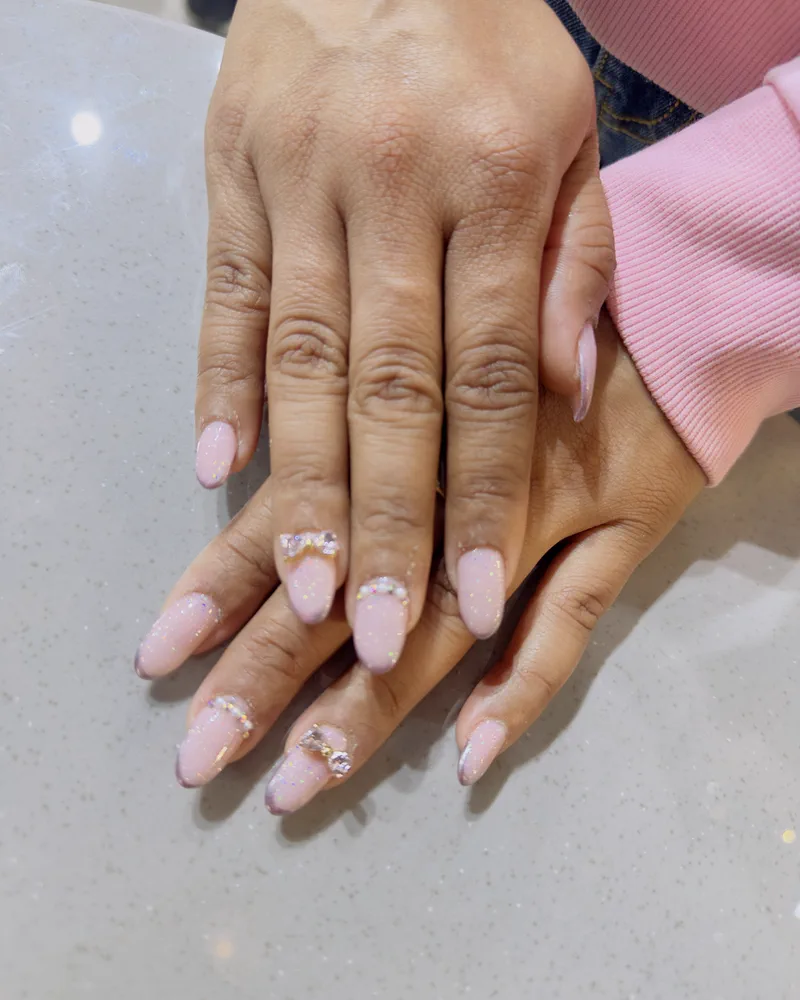
A pale pink almond nail set with crystal detail at Salon By Babita, Haldwani

What an extension is, and what it is not

An extension adds length and structure to a nail that is not currently holding either. It is asked for by three kinds of guest: nails that stay short because they keep breaking, nails bitten down where the habit is one the guest wants to stop, and brides or guests with a function and a date already in the diary.

It is not a nail treatment. Extensions do not make your natural nails stronger by themselves — that is the expectation corrected most often here — and they do not run for months untouched. A refill belongs every two to three weeks, and after that the grow-out puts increasing pressure on the tip and the risk of breaking rises with it.

The other belief worth correcting is that extensions ruin natural nails. They do not. What ruins natural nails is over-filing the plate in the name of grip or strength, and taking a set off at home rather than having it soaked off properly. Both of those are choices, not consequences, and neither happens here.

The standard the work is held to is prep and finishing rather than decoration: a genuinely clean cuticle line, a completely even surface, and a finished nail that still looks thin. Design sits on top of that, and no design compensates for its absence.

  • A refill every two to three weeks

    After that the grow-out increases the pressure on the tip, and the risk of breaking with it.

  • It does not strengthen your nails

    An extension covers and supports. It is not a repair, and it is not sold as one.

  • Removal is what damages nails

    Over-filing and pulling a set off at home — not the extension itself. Both are avoidable.

  • Luxury is the prep, not the art

    Clean cuticle line, even surface, a nail that still looks thin. Design comes after that.

Who this may suit, and who it does not

Suitability here is decided by the nail plate and by what your hands do all day, and it is stated in both directions before anything is booked.

This is for you if

  • Nails that stay short because they break before they can grow.
  • Nails bitten down, where the habit is one you want to stop rather than hide.
  • A wedding or a function with a date already fixed.
  • A normal-to-strong nail plate with some natural length and a straight nail bed — the easiest nail to work on.
  • Nails that already have their own length and only need strength and shine, where an overlay is the answer rather than an extension.
  • Anyone willing to come back for a refill every two to three weeks and to keep the length sensible for their work.

This is not for you if

  • Any fungal infection on the nail, pus, swelling, or a nail lifting away from its bed. Nothing is applied over an infection.
  • A cut, a wound, psoriasis patches on the nail, or a nail already being treated by someone else.
  • A nail plate already so thin that it cannot take any more pressure — a set on it is the thing that does the damage.
  • A nail coming fully away from the bed, changing colour, hurting, or becoming infected repeatedly. That is a doctor's question, not ours.
  • Very long stiletto or coffin shapes for anyone doing housework or field work — they will not last two weeks, and they are discouraged rather than sold.
  • Long nails for hospital and kitchen work, for anyone with small children, and for anyone doing gym or sport. Short and rounded is what survives those days.
  • Anyone expecting the extension to strengthen their natural nails, or to run for months without a refill. Neither is true.
  • Anyone who wants a promise that a set will not break. That depends on how you use your hands, and it is not a promise we make.
  • Anyone whose expectation has not moved after all of this has been explained — the set is not started, and the reason is given.

What is read before anything is filed

The reading starts with the natural nail plate: whether it is thin or strong, whether there are ridges or white spots across it, and whether the cuticle area is clean or swollen. Everything that follows — system, length, shape, and whether a set happens at all — comes out of that.

A healthy nail is a pale pink nail bed, a smooth surface with no ridges, a strong free edge and a cuticle with no swelling in it. A weak nail is equally recognisable: it bends, it peels away in layers from the edges, it gives under light pressure, and it carries white spots or deep ridges. A weak nail is not a refusal — it changes the length, the shape and the system, and that change is explained rather than made quietly.

Some findings end the appointment instead of shaping it. A nail lifting away from its bed, a colour turning yellow or green, or pus around the nail are signs of infection and nothing goes on top of any of them. The same applies to a fungal infection, a previous set that is already lifting, a cut nail, a wound, psoriasis on the nail, and a nail already under someone else's treatment. Where a nail is coming fully off the bed, changing colour, hurting, or getting infected again and again, that belongs with a doctor rather than with a nail technician — and you will be told so rather than worked around.

The nail is then graded for difficulty and you are told which kind you have. A normal-to-strong plate with a little natural length and a straight nail bed is the easiest to work on. A very thin, bitten nail with a short nail bed and an overgrown cuticle is the hardest, because both grip and shape have to be created rather than found. Retention is read in the same conversation: a very oily nail plate, hands in water for most of the day, or a cuticle that has not been prepped properly all predict early lifting, while a cleanly prepped dry plate, a healthy cuticle and hands that are looked after get three to four weeks comfortably.

  • The plate, first and last

    Thin or strong, ridges, white spots — and whether the cuticle area is clean or swollen.

  • A weak nail changes the plan

    Bending, peeling in layers, giving under light pressure — shorter, and a different system.

  • Infection stops it outright

    Lifting from the bed, yellow or green colour, pus around the nail — no set goes over it.

  • Three to four weeks, when the prep is right

    An oily plate, constant water work or a poorly prepped cuticle shorten it every time.

Chosen from your nail, and from your week

Nothing is filed before the history has been taken. Diabetes, thyroid, any skin allergy, and any history of nail fungus or nail psoriasis are asked about by name, and the nail area itself is checked for infection, swelling, a cut, a wound or a previous set that is lifting.

Then the system is chosen, and the three options answer genuinely different problems. Gel suits a healthy nail plate and a guest who wants a natural, light and flexible finish; it is the quicker of the two and gives the most natural look of anything done here. Acrylic is for real length and real strength, and for badly bitten nails that need a whole structure built for them; it takes longer and it is the stronger. An overlay is neither — it is for nails that already have length and only need strength and shine, and it is protection rather than extension.

Length and shape are decided from your hands, not from a picture. Constant water work, your own housework, the gym and small children at home all point to something shorter, stronger and rounder — and so do the jobs where long nails do not survive a shift, which in practice means doctors and nurses, kitchen staff, gym trainers and teachers. Squoval and a short almond spread the pressure across the whole nail and are the shapes that break least; a stiletto and a long coffin put all of it on the tip, where a single knock takes the nail.

What you leave the consultation with is either a plan — the system, the shape, the length, the aftercare and the date of the refill — or an honest reason why the answer is not today. Refusing a length has never lost this salon a guest, provided the reason goes with it.

  • The nail plate — thin or strong, ridges, white spots
  • The cuticle area, and whether it is clean or swollen
  • Lifting, discolouration, pus or swelling anywhere around the nail
  • Diabetes, thyroid, and any skin allergy
  • Any history of nail fungus or nail psoriasis
  • Your occupation, and what your hands do through a normal day
  • Water work, gym or sport, and small children at home
  • How your last set was removed, and whether it was ever pulled off
  • The length and shape you want, against the length and shape your week allows

How the appointment runs

Five stages, and the two that decide whether the set survives happen before anything is applied.

  1. The reading and the history

    The nail plate and the cuticle area are read, and the medical history is taken. If there is an infection, swelling, a cut, a wound, psoriasis on the nail or a previous set that is lifting, the appointment moves rather than proceeds.

  2. Gel, acrylic or an overlay — and the shape

    The system is chosen from the state of the plate, and the length and shape from what your hands do all day. Where a shorter, rounder shape is what will actually last, that is what is recommended and the reason comes with it.

  3. Prep and sanitisation, never shortened

    Tools are sanitised for every guest and files are single-use. The plate is prepped clean, dry and oil-free, and the cuticle area is prepared properly — this is the stage that decides whether the set lifts, and it is not hurried however late the day is running.

  4. The set built, without filing the nail thin

    Length and structure are built to the shape agreed. The natural plate is not filed down for grip: over-filing is what genuinely damages a nail, and it takes months rather than a sitting to grow back.

  5. Finishing, and the refill date

    The cuticle line is left clean, the surface even and the nail still looking thin. You leave with the aftercare and with the refill placed at two to three weeks.

What to expect, and for how long

On a cleanly prepped, dry plate with a healthy cuticle, and on hands that are looked after, a set runs three to four weeks comfortably. Where the plate is very oily, where hands are in water for most of the day, or where the cuticle has not been prepped properly, it lifts earlier — and those three are read at the consultation precisely so that the answer is known before the appointment rather than after.

A refill belongs every two to three weeks regardless. Past that, the grow-out shifts the balance of the nail and puts more pressure on the tip, which is when sets break. The guests whose nails stay healthy for years are the ones who come on time for the refill and use cuticle oil; the ones who struggle are the ones who let a refill run to five or six weeks, and the ones who break a set off at home.

Nothing here is promised unbreakable. How long a set survives depends on how you use your hands — and the shape decides a great deal of it, which is why squoval and a short almond are recommended so often and a long stiletto or coffin so rarely.

What a set is judged on when it comes off matters as much as how it looked going on: a clean cuticle line, an even surface, a nail that still looks thin, and a natural plate underneath that is no worse than it was.

  • Three to four weeks, prepped properly

    An oily plate, constant water work or a poorly prepped cuticle shorten it every time.
  • Refill at two to three weeks

    Past that the grow-out loads the tip, and that is when sets break rather than lift.

  • Shape decides the breakage

    Squoval and short almond spread the pressure; stiletto and long coffin carry it all on the tip.

  • No set is promised unbreakable

    It depends on how you use your hands, and no product on the market changes that.

Keeping the set, and taking it off properly

Most of what decides a set's life happens after you leave. Two of these three are the ones guests actually forget.

  • Use cuticle oil every day. It is the most ignored instruction on this list and the one that prevents lifting more than anything else.
  • Do not open anything with your nails — boxes, stickers, keys. Using nails as tools is the commonest cause of a break, and it is not a product failure.
  • Never remove a set at home. Pulling one off is the single most damaging thing that happens to natural nails, and it is what people mistake for the extension having ruined them.
  • Keep your hands out of water for a long stretch straight after the appointment, and keep the plate dry and oil-free at prep time — those two are where most lifting begins.
  • Come back every two to three weeks for the refill. Letting it run to five or six weeks is what turns an intact set into a broken one.
  • Tell us as soon as anything lifts. A gap lets water and bacteria underneath, and that is how an infection starts rather than a cosmetic problem.
  • Removal is a proper soak-off, done here, when the lifting is excessive, when something is suspected underneath, or when you simply want a break. It is never pulled.

Making extensions last, and removing them safely

In Babita's words

The decisions behind the rules on this page, in the words of the person who made them.

  • The nails that had been bitten for fifteen years

    A guest arrived with nails bitten right down. Three sittings gave the nail bed its shape back, and six months later she had stopped biting.

    A very thin, bitten nail with a short nail bed and an overgrown cuticle is the hardest kind of nail on this pillar — both the grip and the shape have to be built rather than found. Over three sittings the nail bed regained its shape, and six months after the first one she had given up biting altogether. It is the result this salon is proudest of on nails, and it is the reason a bitten nail is treated as difficult work worth doing rather than as work to be turned away.

  • Why prep and sanitisation are never the stage that gets shortened

    Nail work is where a cut corner shows fastest, so the two stages that never move are the two nobody sees.

    Tools are sanitised for every guest and files are single-use, and that rule has no exception however rushed an appointment is. Nail prep is the other: the plate has to be clean, dry and oil-free and the cuticle area properly prepared, because the best design in the salon will lift within five days if the prep underneath it was wrong. It is also the first thing a trainee here is taught — design comes afterwards, and it is what a guest notices only when the prep has failed.

  • It is not the extension that damages a nail

    Over-filing the natural plate, and pulling a set off at home, are what leave nails thin. Both are choices, not consequences.

    Guests arrive convinced that extensions ruin natural nails. They do not. What ruins them is filing the plate thin in the name of grip or strength, and taking a set off at home instead of having it soaked off — and over-filing is the hardest damage on this pillar to put right, because it does not recover in the sitting it happened in. It grows back in about three to four months. The beginner habit worth worrying about is exactly that filing, along with treating a small piece of lifting as a detail rather than as the gap water and bacteria get in through.

  • The length someone asks for, and the length her week allows

    The lesson that took years: refusing a shape does not upset a guest, provided the reason goes with it.

    A very long stiletto or coffin on hands doing housework or field work will not last two weeks, and a hospital, a kitchen, a gym or small children at home decide the length long before taste does. A squoval or a short almond spreads the pressure across the whole nail and breaks least; a stiletto and a long coffin carry all of it on the tip and go in one knock. The thing that took years to learn is that saying so costs nothing — a guest is not upset by a no, she is upset by a no with no reason attached to it.

Nail extension questions

The questions asked at the consultation, answered here instead. Anything not covered is worth a message — an answer costs you nothing and does not commit you to a booking.

Do extensions ruin your natural nails?

No, and this is the belief we correct more often than any other. What damages a natural nail is over-filing the plate in the name of strength or grip, and pulling a set off at home instead of having it soaked off. Neither of those is the extension. Over-filed nails are also the hardest thing on this pillar to put right — they do not recover in the sitting they were thinned in, they take months — which is exactly why we do not do it.

Should I have gel or acrylic?

It is decided from your nail plate rather than from preference. Gel suits a healthy plate and a guest who wants a natural, light and flexible finish; it is the quicker of the two and the most natural-looking. Acrylic is for real length and real strength, and for badly bitten nails that need a full structure built for them; it takes longer and it is stronger. If your own nails already have length and only need strength and shine, neither is right — an overlay is, and it is protection rather than extension.

How often do I need to come back?

Every two to three weeks for a refill. After that the grow-out shifts the balance of the nail and loads the tip, and that is when a set breaks rather than simply lifts. The guests whose nails stay healthy for years are the ones who keep the refill appointment and use cuticle oil; the ones who struggle are the ones who let it run to five or six weeks.

How long will a set actually last on me?

Three to four weeks comfortably, when the plate has been prepped cleanly and dry, the cuticle is healthy, and you look after your hands. It is shorter where the nail plate is very oily, where your hands are in water for most of the day, or where the cuticle was not prepped properly. What we will not do is promise that a set will not break — that depends on how you use your hands, and no product changes it.

Can I have the long shape I have seen in a photograph?

Bring the photograph — it tells us what you like. Whether it will survive your week is a different question. Very long stiletto and coffin shapes are discouraged for anyone doing housework or field work because they will not last two weeks, and long nails generally do not survive hospital or kitchen work, small children, or the gym. A squoval or a short almond spreads the pressure across the whole nail and breaks least; a stiletto and a long coffin carry all of it on the tip. If the answer is a shorter shape, you will get the reason with it.

My nails are bitten right down — is this still possible?

Often, yes, and it is some of the most worthwhile work done here. It is also the hardest kind of nail to work on: a very thin bitten nail with a short nail bed and an overgrown cuticle means both grip and shape have to be built rather than found, and you will hear that at the reading rather than afterwards. Acrylic is usually what gives that nail a whole structure to sit on. One guest had bitten her nails for fifteen years; three sittings gave the nail bed its shape back and six months later she had stopped biting altogether.

Will extensions make my own nails stronger?

No. That is the commonest unrealistic expectation about this service, along with the idea that a set runs for months without a refill. An extension covers and supports a nail; it does not treat it. What we will do is make sure the natural plate underneath comes out of the set no worse than it went in — which is a matter of not over-filing it and of removing it properly.

When would you refuse to do a set?

When there is an infection or swelling around the nail, when the nail plate is already too thin to take any more pressure, and when the expectation has not moved after we have explained what your nail will actually carry. A fungal infection, a lifting previous set, a cut nail, a wound, psoriasis on the nail or a nail already under someone else's treatment all mean no set that day. A nail lifting fully off the bed, changing colour, hurting, or getting infected again and again is a doctor's question rather than ours, and we will say so.

How are they taken off?

With a proper soak-off, here, never by pulling. A set comes off when the lifting has become excessive, when something is suspected underneath it, or when you simply want a break. Taking a set off at home is the single most damaging thing that happens to natural nails and it is what people mistake for the extension having ruined them. Where a nail has been thinned by over-filing or by a bad removal, it does come back — in about three to four months.

What happens with the tools between guests?

Tools are sanitised for every guest and files are single-use, and that rule has never changed here. Nail prep and sanitisation are the two things never shortened however rushed the appointment is — nail work is where a corner cut shows fastest, and a gap under a lifting set is how water and bacteria get in.

What causes a set to lift?

Almost always the prep or the first hours. A plate that was not completely dry and oil-free at prep, a cuticle area that was not prepared properly, and hands left in water for a long stretch straight afterwards are the three causes. A very oily nail plate and daily water work make it likelier on any set. Tell us as soon as you see lifting rather than living with it — the gap is what lets water and bacteria underneath.

Before you decide

The reading that answers most of this without a booking attached, and where the rest of the subject lives.

Tell us what your nails are doing

Describe the nails — whether they break, peel or bend, whether they are bitten — and tell us what your hands do all day. You will get an honest answer about which system would hold on you, what length is realistic, and when the answer is to wait.

Six questions, then a conversation

What are you considering?

Choose the closest one. If something else would suit you better, Babita will say so.

Is there an occasion?

This decides how much time the work needs, and how far ahead to start.

An approximate date is enough at this stage.

Preferred time

We will tell you what is genuinely free that day.

Call the salon

Your answers become a WhatsApp message you can read, edit and send yourself. Nothing is stored on this website, and no one is added to a mailing list.