Hair · Haldwani, Uttarakhand

Nanoplastia or keratin — depth is the difference, not strength of promise

One settles inside the cortex and gives a genuinely straighter fall; the other seals the cuticle and lets your wave show through. What the extra depth changes is not how long the result lasts — that is settled by your hair type — but who may be given it at all.

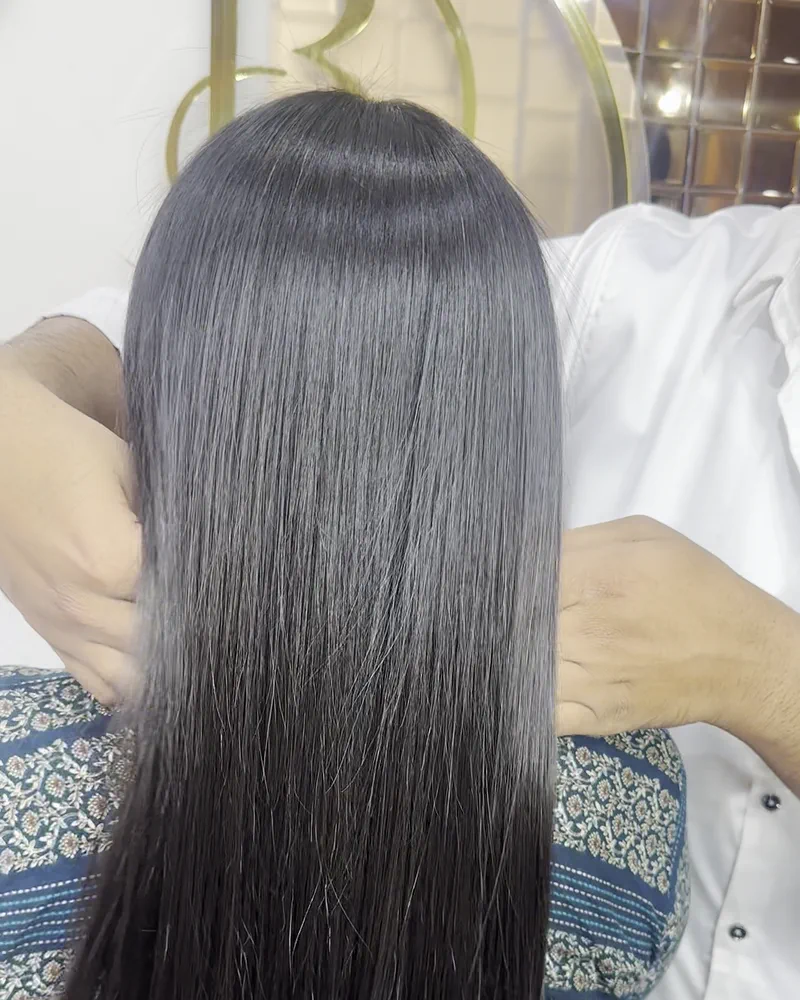
Long dark hair brushed smooth and held out straight from behind at Salon By Babita, Haldwani

What each one is, in one paragraph

Nanoplastia uses a formulation of low-molecular-weight amino acids fine enough to travel past the cuticle and settle inside the cortex, where it is set with heat. Because the deposit sits inside the shaft rather than on it, washing does not strip it the way it strips a surface coating, and the fall is genuinely straighter.

Keratin works at the surface. A professional keratin formulation is put onto and just inside the outer layer, the cuticle lies flat, and hair that swelled in damp air stays where it was dried. Wave and curl are softened and organised rather than removed, and they return intact as the treatment fades.

Neither breaks and rebuilds the hair's bonds, so neither is permanent and neither leaves a border to grow out. What separates them is depth — and the entry requirement that depth carries with it, which is where most of this page is spent.

  • Inside the cortex, or on the cuticle

    Fine-molecule amino acids set within the shaft, against a formulation sealed onto its surface.

  • How long is a question about your hair

    Thick, coarse hair can hold a keratin seal as long as it holds the deeper system. Texture decides it, not the name.

  • Neither is permanent, neither leaves a line

    Both ease away across the length; your own texture returns as a soft transition rather than at a border.

What is read before either is offered

One question changes more here than any other: has bleach or henna ever been on this hair. It is asked before anything else is discussed, because bleach leaves a signature the hands find immediately — wet the hair and it turns gummy, almost dissolving between the fingers — and because that damage is the hardest of all to correct.

Both treatments then need the same wet strand stretched: hair in good order gives a little and springs back, damaged hair either breaks at once or stretches and stays stretched. Where it stays stretched, neither is offered. Where it springs back, the reading also predicts longevity: density and texture are read as part of the same examination, so what you are told about how long it will hold comes from your own hair rather than from a brochure.

The difference is what happens next. Nanoplastia has a genuine pass-or-fail step — a strand processed and read exactly as the full service would be, in a hidden section, before an appointment is confirmed. If that strand loses elasticity, feels gummy or breaks, the treatment is not performed, and no version of doing it carefully is offered afterwards. Keratin runs a strand test where colour or previous chemical work makes the outcome uncertain, and where henna is anywhere in the history it is not optional there either.

Histories are not always complete, so the hair is trusted over the account. A guest who reported only colour has had the service stopped at the basin when the hair went gummy and old bleach surfaced; a repair treatment took the slot instead. Stopping partway through is a legitimate outcome of this assessment rather than a failure of it, and the same applies to the basin check before a keratin sealing pass.

  • Bleach or henna, ever

    The one answer that most changes what can be done — asked directly, before anything else.

  • Gummy when wet is a stop

    Hair that dissolves between the fingers when wet carries the damage hardest to correct, for either treatment.

  • One has a pass-or-fail gate

    The deeper system's strand test happens before the booking is confirmed, not at the start of the appointment.

  • The hair overrules the history

    Where the basin contradicts what was reported, the service stops and the plan changes that day.

Read across, not down

Each row is a property of the treatment rather than a mark against it. Depth is a trade, not a ranking.

What is being compared Nanoplastia Keratin
Where it works on the hair Past the cuticle and inside the cortex, set with heat, so washing does not strip it the way it strips a coating. On and just inside the cuticle. The internal bonds are left alone — nothing is broken and nothing is reformed.
The result you see A genuinely straighter fall with weight and movement kept, and root volume reduced rather than erased. Frizz that stops lifting and a wave that is softer and better defined — straightening becomes easy rather than being performed.
The complaint it answers Dense, coarse or very wavy hair whose mornings are dominated by it, and where a keratin treatment has already proved too light. Frizz that lifts the moment the weather changes, on hair in reasonable condition that behaves the rest of the time.
How long it holds Months rather than weeks on hair that suits it, stated as a range — where you land depends on coarseness, wash routine and water. Weeks to a few months, and on thick, coarse hair as long as anything kept here. Hair type decides this, not the treatment's name.
The entry requirement A processed strand test is standard rather than optional, read before the booking is confirmed. A failed test ends it. A strand test where colour or previous chemical work makes the outcome uncertain, and always where henna is in the history.
On bleached or lightened hair The most common refusal here. Bleach leaves the cortex porous, which is precisely the layer this treatment works in. Declined where the ends are porous and chalky, but frequently the treatment that can still be offered to hair the deeper system was refused for.
On fine hair Often not a good idea. Reducing root volume is part of what it does, so fine hair can end up looking flatter and thinner rather than smoother. Possible with a lighter formulation, less of it, and application kept well away from the scalp — where fine hair is also limp, conditioning work may be the honest answer.
What happens to curl Substantially reduced. If keeping your pattern matters, this is the wrong one to book. Kept. Loosened and organised, with far less frizz between the curls, and it returns fully as the treatment fades.
Colour around it Sequenced with gaps decided together. Bleach and this treatment do not belong on the same head in the same season. Usually colour first with a gap, since the sealing step can lift a fresh tone and colour applied afterwards behaves unpredictably on a sealed cuticle.
Time in the chair A long appointment, deliberately so — application alone runs an hour to ninety minutes, and processing is timed rather than extended. Two to four hours, decided by length, density and how much sealing the hair needs.
Repeating it Only once it has genuinely eased off and the hair has been reassessed. Stacking strong smoothing is cumulative — each sitting is fine, and the fourth is where hair gives up. When the previous treatment has genuinely worn off. Re-sealing hair that is still sealed adds weight without benefit, and on finer hair reads as limp.

The boundary, stated plainly

Choose on what you want the hair to do, and then find out whether it is allowed. If you want your wave kept and only the frizz managed, the sealing treatment is the answer and the deeper one is over-specified. If you want a genuinely straighter fall on dense, coarse or very wavy hair, the deeper system is what delivers that — subject to a strand test that is standard rather than optional.

Longevity is not the deciding line, and it is worth saying so directly because it is how these two are usually sold. How long either holds is a question about your hair type, not about the chemistry: on thick, coarse hair a keratin seal holds as long as anything kept here. What the extra depth genuinely changes is eligibility — a keratin treatment can be offered to hair that the deeper system would be declined for.

Where the complaint is condition rather than frizz or straightness, neither is the answer: hair that is porous, rough and snapping needs its protein back before anything is sealed or deposited. And where a permanent change is what is actually wanted, that belongs with the structural services and their own trade-offs, stated first.

  • Depth buys straightness, not time

    What it costs is eligibility — the deeper system is the one refused most often at this salon.

  • Condition outranks both

    Porous, snapping hair gets repair first; the smoothing conversation is picked up afterwards if the hair earns it.

Questions about the choice itself

Each treatment page answers the questions about that treatment. These three are the ones asked when both are on the table.

My hair failed the nanoplastia strand test. Does that mean keratin is allowed?

Not automatically, and it is a fair question because the lighter treatment is often exactly what is offered next. A failed strand can fail in two different ways. Where the hair simply cannot carry a deep-acting formulation but the wet strand still springs back and the ends are sound, a keratin treatment is frequently the right alternative and is proposed on that basis. Where the strand went gummy, broke, or stretched and stayed stretched, neither is offered: a sealing pass runs hot, and that heat on a weakened shaft is what breaks hair along its mid-length instead of smoothing it. In that case what you get is a repair plan with a timeline and a date to be reassessed.

I have had keratin for years and want something stronger. Is nanoplastia the next step up?

It can be, and this is one of the clearer cases for it — dense, coarse or very wavy hair that a keratin treatment has already proved too light for is precisely who the deeper system suits. But it is not an upgrade you are entitled to by having had the lighter one: the hair is read from scratch, the full chemical history is taken again, and the strand test is processed and read before an appointment is confirmed. Years of repeated smoothing also count, because the effect is cumulative in a way single appointments hide. If the answer is that the hair has been asked enough of, that is said, and a condition check replaces the booking.

Which of the two actually holds up in our humidity?

Both are built for it, and humidity is not the axis that separates them. Frizz starts when the cuticle swells in damp air, and both treatments stop that happening — one by keeping the cuticle sealed flat, the other by changing how the shaft behaves from the inside. What differs is the finish underneath: with the sealing treatment your wave is still there on a damp morning, softer and better defined; with the deeper system the fall is straighter. What genuinely shortens either in this region is not the weather but the water — hard water shortens a smoothing result faster than heat does, which is why a chelating shampoo is part of the plan and a filter earns its cost.

The two treatments in full

Each page carries its own refusals and its own aftercare — including the pages that may talk you out of a booking.

  • Nanoplastia

    The deeper system: the entry test in full, and what is offered when it is failed.

  • Keratin

    The sealing treatment: the basin check, the shampoo condition, and when it is postponed.

  • Hair botox

    Where you are sent when the complaint is condition rather than frizz or straightness.

  • All hair treatments at the salon

    Eight treatments, what each is actually for, and how the choice between them is made.

The reading behind the decision

None of this needs a booking, and the first two answer most of the questions this page raises.

In Babita's words

  • The recommendations she is proudest of are the ones that sold nothing

    Where the honest answer is that no treatment should be done yet, that is the answer given — and it is the answer this salon was built on.

    A plan that is smaller than the one the guest asked for — a cut and a course of conditioning before anything chemical, or one treatment now and the second three months later — costs that day's booking and holds where the larger one would not. Those are the sittings she names when asked what she is proudest of, and the guests who had them are still here, arriving now with their mothers and their sisters.

Tell us your hair's chemical history

List what has been on your hair — colour, bleach, henna, any previous smoothing — with rough dates, and say how straight you want it to fall. You will get an honest first view on which of the two is even a candidate, and what a strand test would need to show.

Six questions, then a conversation

What are you considering?

Choose the closest one. If something else would suit you better, Babita will say so.

Is there an occasion?

This decides how much time the work needs, and how far ahead to start.

An approximate date is enough at this stage.

Preferred time

We will tell you what is genuinely free that day.

Call the salon

Your answers become a WhatsApp message you can read, edit and send yourself. Nothing is stored on this website, and no one is added to a mailing list.