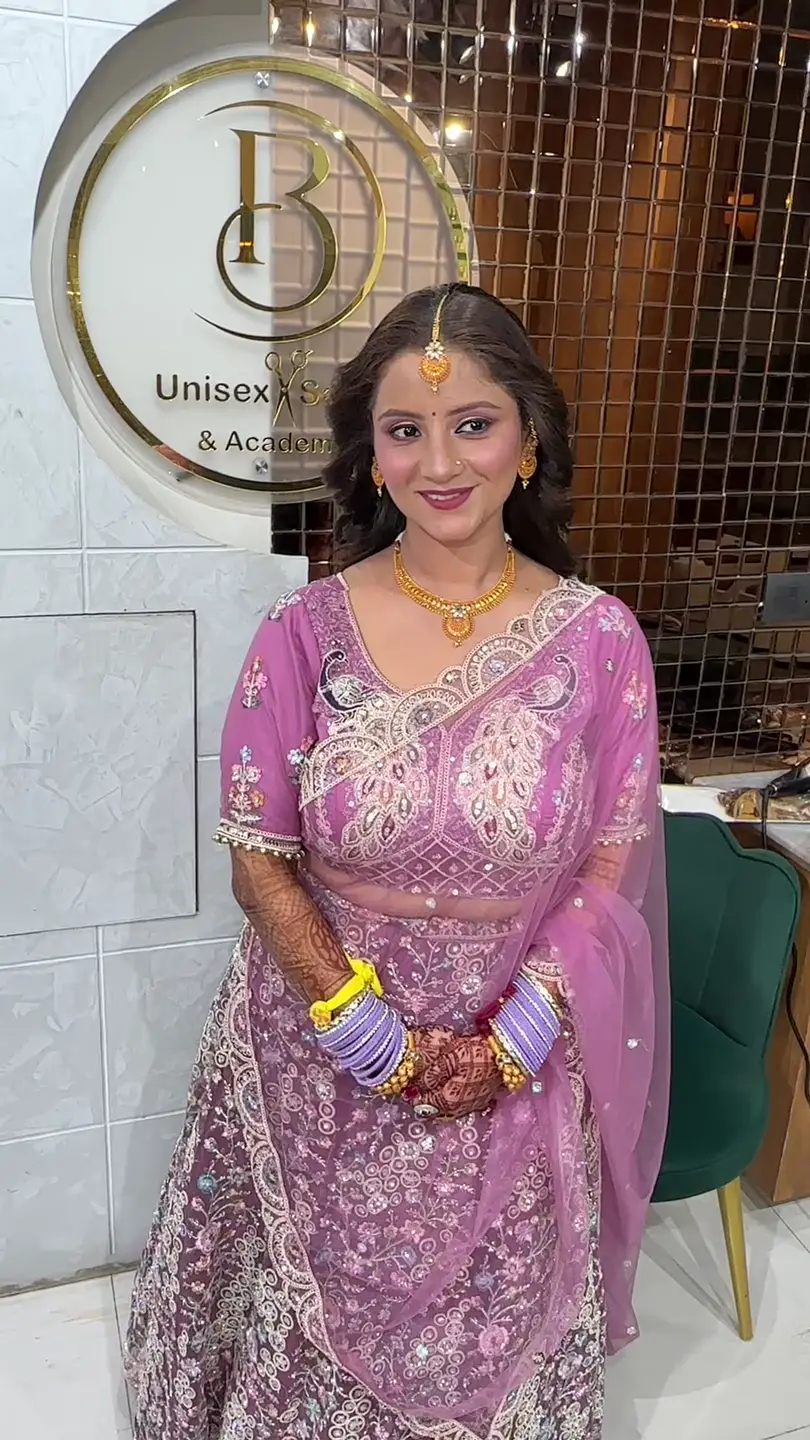
Bridal · Haldwani, Uttarakhand

Luxury bridal makeup, planned around your day

A wedding face is built weeks before it is worn. Babita reads your skin, plans it with your outfit, your venue and your photographer's light in mind, and settles the look at a trial — so nothing about the morning is a first attempt.

Bridal makeup by Babita at Salon By Babita, Haldwani

What a bridal booking here means

Bridal makeup is not a service you buy on the morning of a wedding. It is a plan that starts with a conversation, runs through your skin in the weeks before, and is tested at a trial while there is still time to change it.

A bridal booking here means three things planned together — hair, skin and makeup — across more than one function. A single look for a single evening is party makeup, and it is booked as party makeup rather than dressed up as something larger. The first appointment once your date is fixed is the consultation, and the active plan runs from about ninety days out: three months is what skin work needs, and it is what treated hair needs to settle into behaving like your own hair again.

The look is built around your features rather than a reference photograph. Depth, coverage and finish are matched to your skin tone in daylight, then checked against the light you will actually be in — a hall, a lawn at four o'clock, a photographer's flash. Traditional and contemporary bridal looks are both familiar territory; which one suits you is a decision made with your outfit and jewellery in front of us, not in advance.

Which professional line is opened for your face is part of that decision. Premium international ranges — among them MAC, NARS, Tarte, Dior Beauty and Burberry Beauty — are selected against your skin type, the event, the photography and the finish you want. No bride receives every brand, and you may ask what is being used on you at any point in the day.

Each function you book gets its own look rather than the wedding face repeated — the wedding day is planned first and everything else is balanced against it. High-definition is the default finish for the wedding day itself, and it is departed from only when the skin says so rather than when a different name is asked for.

On a function day the work is split so that it fits the morning — hair, makeup and draping worked by different hands at once rather than one after another — while the plan itself and the final look stay Babita's to supervise. She has spent fifteen years at the chair and ten of them running her own salon in Delhi. Bridal is not the salon's side offering; it is the work she built the rest of the salon around.

Brushes are washed with a brush cleanser after every bride and dried completely before they are used again, and sponges are disposable — used once and thrown, never carried to a second face. It is not a detail brides usually think to ask about, and it is one of the few things in this trade where the correct answer costs money rather than saves it.

  • One bride per date

    The day is not shared with another wedding, so the schedule has room in it.

  • The consultation is the first booking

    Sixty to ninety days out: skin, hair, functions and outfits read before anything is offered.

  • A trial before the date

    Base, eyes, lashes and drape settled while there is still time to change them.

  • Skin and hair start three months out

    Both are courses rather than sittings, and both are scheduled backwards from your date.

  • Products chosen per bride

    Professional lines, selected for your skin and your light rather than issued as a set.

  • Clean brushes, single-use sponges

    Brushes washed and dried fully between brides; sponges are thrown away rather than reused.

Who this suits, and who it does not

A wedding is a bad day to discover a treatment was the wrong choice. This is stated plainly in both directions before anything is booked.

This is for you if

  • Brides who want to look like themselves at their best, rather than like the photograph they arrived with.
  • Anyone who wants the date to themselves — one bride is booked per date, so the morning is not shared with another wedding.
  • Anyone marrying in wedding season who can give the plan a few weeks — enough time for skin work and a trial.
  • Brides with several events — engagement, haldi, mehendi, reception — who want each look planned as a set rather than repeated.
  • Anyone whose day will be heavily photographed or filmed, where the base has to hold under flash and continuous light.
  • Brides travelling in from Nainital, Bhimtal, Kathgodam or elsewhere in Kumaon who can plan the trial around one trip.
  • Anyone who wants to be told honestly what their skin will and will not allow before the date.

This is not for you if

  • A bride who wants an exact copy of a face with different bone structure or a different skin tone — it can be adapted, but not reproduced, and we will say so.
  • Skin under active dermatological treatment, or recovering from a clinical procedure, until the treating doctor is comfortable. Makeup waits; it does not overrule.
  • Anyone expecting airbrush to be the answer for every skin. It is refused outright on skin that is very dry and flaking, where it lifts into patches, and on skin that is textured or has acne actively out, where the fine even layer it lays down reads as unevenness rather than covering it. On both, a hand-applied base gives more control and a better result.
  • A wedding morning with acne actively out in raised, inflamed spots is not a morning for a high-definition base — it sharpens exactly what it is being asked to hide. A traditional matte base is used instead that day, and it is a better outcome than the finish that was originally planned.
  • Anyone wanting a product on the day that was not on their face at the trial. Nothing untested goes on a bride on a wedding morning, however good the case for it is — the trial is where a product earns its place, and there is no second window after it.
  • A date inside about fifteen days, where a full treatment plan is wanted. Makeup and basic grooming are still done and done properly; the treatment plan is not, because the work that needs weeks cannot be given weeks. That is said before you book rather than after.
  • Anyone wanting a new treatment in the final week. No peel, no bleach, no first-time facial and nothing untried goes on a bride in the last seven days — a reaction needs somewhere to happen, and that week cannot host one.
  • Anyone who would rather not be asked questions. The consultation is the service; without it this becomes guesswork with a wedding attached.

What is read on your face before anything is opened

Five things, in the same order every time: skin type and how oily it runs, anything active on the skin — a breakout still inflamed, or pigmentation — the undertone, the shape of the face, and the shape of the eye. It takes ten to fifteen minutes and it happens before a single product is opened, because each of the five decides something different about what follows.

Skin type is decided by a test rather than by looking. The face is cleansed and left alone for fifteen to twenty minutes, then blotted with a tissue: oil at the T-zone only reads as combination, oil across the whole face reads as oily, and a tissue that comes away clean reads as dry. That answer picks the primer, and the primer is what decides whether a base is still there at hour eight.

Undertone is read in natural daylight, at a window. Salon tube light shifts it, which is the single most common reason a base looks correct in the chair and wrong in a photograph. Shade is then matched at the jawline in the same light — never on the hand, and never on the cheek, because both give a reading that leaves a visible line where the face meets the neck.

Face shape and eye shape change the plan rather than the products. Round, square and long faces each move contour placement somewhere different, and a hooded eye — where the crease does not show with the eye open — needs the whole eye plan rebuilt rather than adjusted, because anything blended into a crease that is not visible disappears the moment the eye opens.

  • Five reads, in a fixed order

    Skin type, anything active, undertone, face shape, eye shape — before any product is opened.

  • Skin type is tested, not guessed

    Cleansed, left fifteen to twenty minutes, then blotted — the tissue gives the answer.

  • Undertone read at a window

    Salon tube light shifts it, which is why a base can be right in the mirror and wrong in a photograph.

  • Shade matched at the jawline

    Not the hand, not the cheek — the jawline is where face and neck have to agree.

The consultation

Nothing is offered before your skin has been read. The first sitting is a conversation and an examination — forty-five minutes to an hour, sixty to ninety days before the date — and it ends with a plan you can say no to.

What comes out of it is specific: whether your skin needs work before the date and how much time that needs, which base and finish suit you, whether lashes are right for your eye shape, and how the look changes across your events. If the honest answer is that fewer treatments will serve you better, that is the answer you get — a smaller plan that holds is worth more than a longer one that does not.

You are quoted after this, not before. Bridal pricing depends on the events, the looks and the preparation involved, so a figure given before your skin has been seen would be a guess dressed as a price.

  • Skin type, sensitivity, and anything active — breakouts still inflamed rather than healed
  • Pigmentation, and every cream, serum and prescribed medicine currently in use
  • Hair texture, the full chemical history, elasticity by hand, and the scalp
  • The water at your home, and how often the hair is washed
  • Recent facials, peels, threading, bleach or clinical treatments, and their timing
  • Any reaction or allergy history, including to lash adhesive and pigments
  • How many functions there are, and on which days
  • Whether each venue is indoors or outdoors, and at what time of day
  • The colour of your outfit, jewellery and dupatta for each event
  • What you have disliked about your makeup before — usually the most useful answer of all

How the day is arrived at

Seven stages, spread across months rather than one morning. Preparation happens at the salon; the function days are worked at your venue. Timings are the ones we plan to; your day is confirmed against your own schedule.

  1. The consultation

    45–60 minutes, 60–90 days out

    Your skin and hair read in full, then three questions about the wedding itself: how many functions and on which days, indoors or outdoors, and the colour of the outfit and jewellery. It is where the honest arithmetic happens — including whether the time you have left carries the plan you have in mind.

  2. Skin and hair, planned backwards from the date

    From about three months before

    Both start together and both are courses rather than sittings. Everything chemical — smoothing, colour, peels — is placed to finish at least three weeks before the date, and the last seven days are kept clear of anything new. This stage is the one brides most often skip and most often regret.

  3. The trial

    2–2.5 hours

    Hair and makeup both, built as they will be built on the day, with your dupatta or veil and jewellery present. It ends in a record rather than an opinion: photographs from several angles, the product and shade list, and a note of every change you asked for.

  4. The week before

    Seven days out

    The agreed look is final from this point, so times are fixed against your ceremony schedule, any adjustment from the trial is noted, and the kit is set aside for your face — including anything ordered specifically for you.

  5. Wedding morning: hair, then skin and base

    You sit down 4–5 hours before the function

    The whole service runs four to five hours end to end, of which the makeup itself is two to two and a half; the rest is hair, draping and the touch-up. Hair is set for the drape it has to carry. Skin gets a full fifteen to twenty minutes of prep — cleansed, toned, hydrated, then primed for the conditions of the day — because every minute saved there is paid back with interest by a base that will not sit. Coverage is corrected and balanced in natural light where possible, built where it is needed and left alone where it is not.

  6. Eyes first, then the base

    The eyes are built before the base, not after it — shadow, liner and lashes, all of it, to the plan agreed at the trial and with lashes chosen for your eye shape rather than a standard pair. The reason is simple: shadow fallout lands on whatever is underneath it, and a finished complexion is not something to be cleaned up. With the eyes done, the face is colour-corrected, based, concealed only where the base did not finish, and set; then brows, contour, blush, lips and highlight; then the setting spray, last, over everything. The dupatta or veil is draped and pinned with you standing, so it sits the way it will sit all evening.

  7. Two layers, and no more

    A bridal base is built in at most two layers. A third is where it stops reading as skin: it cakes, it settles into everything it is meant to smooth, and it photographs patchy — which is the one place a wedding face cannot afford to fail. Where more coverage is genuinely needed it is placed only where the need is, rather than added across the whole face. If the choice is airbrush rather than a hand-applied base, the sitting runs thirty to forty-five minutes longer on the same face, and that time is scheduled rather than found on the morning.

  8. The last look, and what you keep

    30–45 minutes before you leave

    That half hour is planned in rather than borrowed. Five things are checked before you stand up: that face and neck match, that the base has no visible line anywhere it was blended, that the eyes are symmetrical, that every lash is down along its whole length, and then the face is photographed twice — once with flash and once without. Both are looked at before you are asked to get up, because a base can be right in the room and wrong in the frame, and the frame is what survives the day. The drape is checked with you standing, and a touch-up kit goes to whoever is with you: blotting sheets, setting spray, spare lashes and adhesive, pins, tape and a mehendi-stain remover among them.

  9. The last touch-up before the photographer starts

    10–15 minutes before

    Not on arrival, and not an hour earlier. Ten to fifteen minutes before the photographer begins, the face is blotted and re-set with setting spray, so what the first frames record is the base at its best rather than the base as it was two hours ago. It is a small piece of scheduling and it changes the photographs more than most brides expect.

What to expect on the day

A face that is planned to last a full ceremony day, photograph honestly, and stay comfortable enough that you stop thinking about it by mid-morning.

Comfort is treated as part of the result, not a compromise against it. Weight is kept off the skin where it is not doing work, lashes are chosen so your eyes are not fighting them by the reception, and nothing is set so hard that your own expression stops showing through. The finish is built to read as skin in person and hold its depth under a photographer's light.

In hours: a high-definition base holds six to eight before it wants a light touch-up, and an airbrush base eight to ten, because the layer it lays down is thinner and more even and so has less to shift. Neither number is a promise made in isolation — both assume the base was set with a finely milled translucent powder and sealed with a long-wear setting spray, which is the combination that actually does the holding.

Photography is planned for as a separate problem from wear, because a face can survive the day and still fail the frame. Two things throw flashback — the grey-white cast that turns up only in flash photographs and never in the mirror: powders heavy in silica and built on a white base, and SPF in a primer or foundation. So the powder used is translucent, non-silica and flash-tested on the warm side of neutral, and where your day is being photographed under flash the base carries no SPF at all. On camera the skin also reads lighter and flatter than it is, so the foundation is taken about half a shade deeper and warmer and the contour a little further than it would go for the room. For an indoor evening function the base goes warmer again and the highlight comes down, because indoor evening light flattens and drains a face that looked correct in daylight.

What it depends on is stated rather than promised: how your skin has been prepared, the weather and the venue, how long you are in it, and how the day itself goes. A base can be built to survive a vidai; no base is built to survive being untouched for eighteen hours without a single blot.

Season is planned for rather than hoped through. A summer date is built lighter, on sweat-resistant products, with extra touch-up time written into the schedule; an outdoor daytime function takes the hair up so it stays settled in the heat, and where sun protection is needed it goes on as its own step under the makeup — a chemical sunscreen twenty minutes ahead, left to set, with an SPF-free primer and foundation over it, so the protection is worn without the base carrying anything that will flare in a flash frame. A monsoon date moves the hair work earlier — settled, smoothed hair holds a set in humidity where untreated hair will not — and a winter date puts weeks into hydration before a single product is chosen, because dry skin lifts base however carefully it is applied.

  • Planned for a full ceremony day

    Built for the length of your actual schedule, with a touch-up kit for lip and blotting.

  • Six to eight hours, or eight to ten

    High-definition against airbrush, before either wants a light touch-up.

  • Checked in daylight and under flash

    Matched at the trial in both, because a base that flatters in a mirror can go grey in a photograph.

  • No silica-heavy white powder, no SPF in the base

    Translucent, non-silica, flash-tested powder over an SPF-free base — the two places flashback is decided.

  • What it depends on

    Skin preparation, weather, venue and how long the day runs — all discussed before the date, none guaranteed away.

  • Planned for your season

    Summer builds lighter with touch-up time scheduled; monsoon moves the hair work earlier; winter puts weeks into hydration first.

  • Across your events

    Engagement, haldi, mehendi and reception looks are planned as a set, each lighter or heavier as the event asks.

After the day

Long-wear makeup is designed to stay put, which means removing it properly matters more than usual — particularly with another event the next morning.

  • Take it off the same night, however late it is and however tired you are. A night spent in long-wear base is the most common cause of the small congested bumps that turn up across the face in the days after a wedding — hours of heavy coverage, then a night it was not taken off.
  • Remove it in that order: lashes first, then the base with an oil-based or biphasic remover, then a light cleanser, then moisturiser. Taking the base off before the lashes drags adhesive through skin that has already had a long day.
  • Use a dedicated lash-glue remover on the lashes and give it time to work. Never pull — dry or not, a strip pulled off takes your own lashes with it.
  • Once the makeup is off, leave the skin alone: no scrub, no peel, no active serums — retinol, vitamin C, acids — no bleach, no threading and no steam. Skin is already stressed after a bridal face, and most of what brides report as a post-wedding breakout follows one of those going on top of it.
  • Give a normal facial, or any other treatment, at least five to seven days after the wedding. Until then it is a gentle cleanser, a moisturiser and sunscreen every day — that is the whole routine, and it is enough.
  • Rehydrate simply — a plain moisturiser and water — before the next event, rather than a rescue mask you have never used before.
  • Tell us what did not hold. A base that shifted at hour ten is information we use for your reception look and for the next bride.

Products selected for a bride

Ranges chosen against skin type, event, photography and finish. No bride receives all of them, and you can ask what is on your face at any point.

  • Long-wear base and setting

    Selected when the day runs long, moves between indoor and outdoor light, and will be photographed throughout.

    MAC · Professional base and setting range

    A base built to hold through a full ceremony day in warm weather, matched to skin tone in daylight rather than under the salon's own lamps.

  • Skin-true colour

    Selected when the brief is a bride who looks like herself in daylight photographs, not a heavier ceremonial finish.

    NARS · Complexion and cheek range

    Depth of pigment without a chalky cast on medium and deep Indian skin tones — the difference that decides whether a photograph looks like the person or like the makeup.

  • Humidity and tears

    Selected for the parts of the face that have to survive the vidai — waterline, lashes, and the hours after them.

    Tarte · Water-resistant eye and complexion range

    Wear that holds through humidity and crying, so the eye does not have to be rebuilt between the ceremony and the reception.

  • A finish that reads as skin

    Selected for brides who want a light, luminous finish rather than full coverage, and whose skin is prepared enough to carry it.

    Dior Beauty · Luminous base and lip range

    Used where the plan calls for restraint — a base that lets texture and colour show through, which only works when the skin work was done in advance.

  • Quiet, tailored colour

    Selected for engagement, mehendi and reception looks where the outfit is doing the talking.

    Burberry Beauty · Eye and lip colour range

    Muted, wearable shades for the events around the wedding day, where a bride usually wants to look composed rather than made up.

Who is doing your makeup

  • Fifteen years of bridal work, ten of them running her own salon

    Bridal makeup at Salon By Babita is done by Babita. It is not delegated to whoever is free that morning, and it is not the salon's side offering.

    Ten of those years at New Look Salon, GTB Nagar, Delhi

    Delhi brides compare artists, ask what is going on their face, and say so when a base breaks by the reception. A decade of answering that taught the working habits this page describes: trial before the date, skin read weeks ahead, and a product chosen for how it behaves at hour twelve rather than how it looks at hour one.

  • A bridal plan is read backwards from the date, or it is not a plan

    Three months for skin and hair, everything chemical finished three weeks out, and nothing new at all in the last seven days.

    Almost everything that goes wrong in bridal work is a timing failure rather than a technique failure. Skin and hair are both courses and both want three months. Smoothing, colour and peels all want at least three weeks between them and the date — not only to settle, but so there is still room to correct them if they land wrong. And the final week adds nothing: no peel, no bleach, no first facial, nothing that has never been on that face before. Under about fifteen days she does not take a treatment plan on at all, and says so before anything is booked rather than after.

  • The trial exists to leave a record, not to preview a look

    Photographs from several angles, the product and shade list, and every change the bride asked for — written down before she leaves.

    A wedding morning runs to somebody else's schedule and favours nothing that has to be decided in it. So the trial ends in three things held on file against the bride's name: photographs of the finished look from several angles, the list of products and shades used, and a note of every change she asked for. That record is what makes the morning execution rather than judgement — and it is what lets the same face be built by another pair of hands in the team if the day ever has to be covered by someone else.

  • A reaction at a trial is the appointment working

    The product comes off, the trial stops there, and the product plan is changed rather than worked around.

    When a bride's skin objects to something in the chair, the trial ends there. The product is removed immediately, something soothing goes on, and the whole product plan is replaced — not adjusted around, replaced. Nothing that produced a reaction goes near that face again. This is the argument for having a trial at all: a reaction has to happen somewhere, and weeks before the date, in a chair, with time to test the replacement properly, is a far better venue for it than a wedding morning.

Bridal questions

The questions brides ask before booking. Anything not answered here is worth a message — a question answered without a booking is still an answer.

When should the trial happen, and what happens in it?

Ideally two to four weeks before the wedding — late enough that your skin is close to how it will be on the day, early enough to change the plan. Bring your dupatta or veil and your jewellery. The full face is built exactly as it will be built on the day, then photographed in daylight and with flash so you can judge it the way your photographs will.

Will I look like myself, or like the photograph I sent?

Like yourself. A reference photograph tells us what you are drawn to — the finish, the depth of colour, the mood — and that is genuinely useful. Reproducing a face built on different features and a different skin tone is not, and if that is what is being asked for we will say so at the consultation rather than on the morning.

What if my skin breaks out close to the date?

Tell us as soon as it happens, and expect the answer to be that nothing new goes on it. Inside the last seven days there is no fresh product, no emergency facial and no peel — the risk of a reaction outweighs any benefit a treatment could deliver in the time left. What is done instead is a gentle hydrating clean-up, spot care, and corrective makeup on the day, which handles a settled breakout far better than most brides expect. An inflamed, over-treated spot is genuinely hard to cover; a calm one is not. This is also why the skin schedule is planned backwards from your date, with the harsher work kept well away from the final fortnight.

HD or airbrush — how is that decided?

HD is the default for the wedding day, and it is departed from when your skin or your venue gives a reason. Airbrush lays down a fine, even layer and suits skin that is smooth and balanced — it holds eight to ten hours against HD's six to eight, and it is what is chosen for an outdoor daytime function, in a matte finish, because it survives heat and sweat better than anything applied by hand. It is refused outright on skin that is very dry and flaking and on skin that is textured or has acne actively out, where that fine even layer reads as unevenness instead of hiding it. Where the skin has raised, inflamed spots on the morning, a traditional matte base is used rather than either. Whichever is chosen, coverage goes where it is needed and nowhere else. The two are also mixed more often than brides expect — an airbrush base with contour, blush and highlight worked in by hand is the combination that reads most like skin.

How long will it hold?

Six to eight hours on a high-definition base and eight to ten on an airbrush one, before either wants a light touch-up — and it is planned for the full length of your schedule, which is why the schedule is asked for. Those hours assume the base was set with a finely milled translucent powder and sealed with a long-wear setting spray, and that the primer underneath was chosen against your actual skin type rather than a guess: on oily skin a mattifying, pore-filling primer is the single product doing most of the work. Realistically, lip needs redoing after meals and the T-zone may need blotting in warm weather — that is what the touch-up kit is for. A result that depends on skin preparation and weather is described that way rather than guaranteed.

I have sensitive skin and have reacted before. Can you work with that?

Yes, and it is exactly why the consultation asks about reaction history, current products and lash adhesive. Where there is any doubt, a patch test is done well before the date and the base and adhesive are chosen around it. If your skin is under a doctor's care, we work to what the doctor allows.

Can the engagement, mehendi and reception looks be planned together?

That is the better way to do it. Planned as a set, the looks change weight and colour across the events instead of repeating the wedding-day face three times, and your skin gets a schedule that accounts for all of them rather than one date.

What if I do not like something at the trial?

Say so then — that is what the trial is for, and a bride who speaks up saves us both the morning. Changes are noted against your name and the adjusted plan is what gets executed on the day. It is far easier to change a trial than to change a face an hour before the ceremony.

Before you decide

Tell us your date

Send your wedding date, your venue and the events you need covered. You will get an honest answer about what the remaining time allows — before anything is booked.

Six questions, then a conversation

What are you considering?

Choose the closest one. If something else would suit you better, Babita will say so.

Is there an occasion?

This decides how much time the work needs, and how far ahead to start.

An approximate date is enough at this stage.

Preferred time

We will tell you what is genuinely free that day.

Call the salon

Your answers become a WhatsApp message you can read, edit and send yourself. Nothing is stored on this website, and no one is added to a mailing list.