
Hair · Haldwani, Uttarakhand
Nanoplastia, and the test it has to pass first
The deepest-acting smoothing system offered here — which is exactly why it is the one refused most often. How long it holds depends on your hair type and condition, not on the treatment's name. Your chemical history and a strand test decide whether it may be used at all, and that decision is made before an appointment is held.
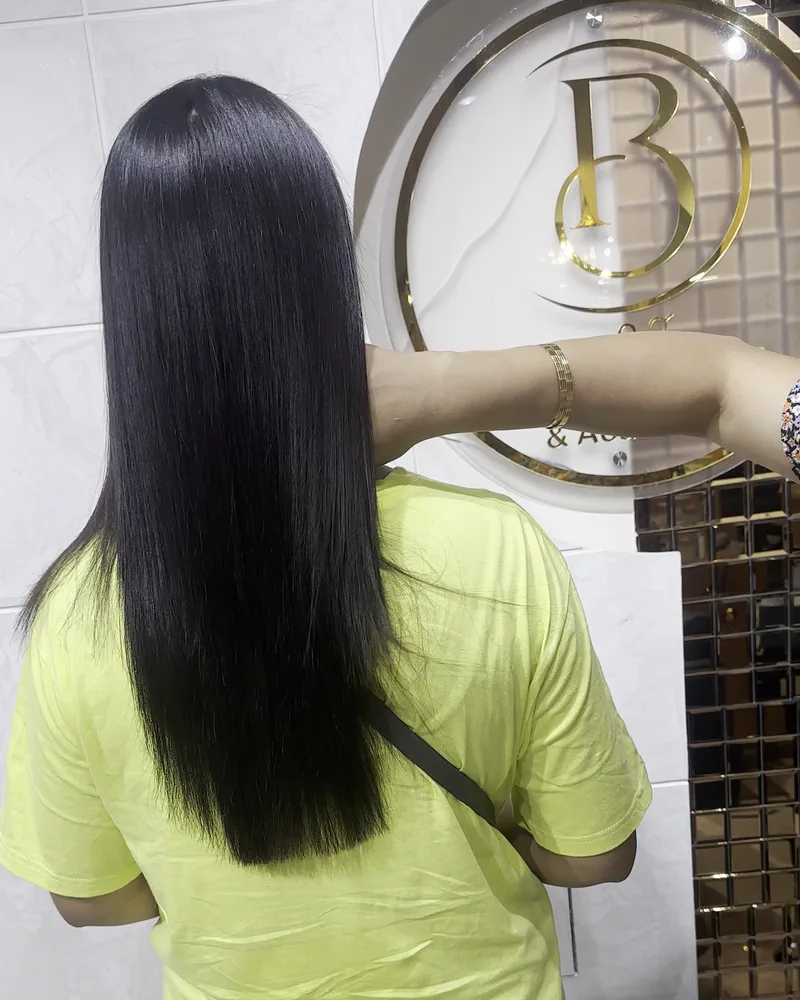
What nanoplastia does differently
Nanoplastia uses a formulation of low-molecular-weight amino acids and conditioning agents fine enough to travel past the cuticle and settle inside the cortex, where it is set with heat. Because the deposit sits inside the shaft rather than on it, washing does not strip it the way it strips a surface coating. How long it then holds is a question about your hair rather than about the chemistry — texture and density decide that, and they are read before anything is promised.
Where it lands is between the two ends of this hub. It goes further than a keratin seal and holds straighter for longer, but it does not break and rebuild the hair's bonds the way rebonding does, so the change is not permanent and it softens away rather than ending at a border. Guests usually describe the result as their own hair on a very good day, held for months.
The lines kept for it are formaldehyde-free, which is one of the reasons it is preferred here over older straightening chemistry. That is a statement about the product, not a claim that a strong treatment is a mild one; it is still the most demanding thing done to hair in this salon, and it is treated that way.
The depth that makes it effective is also what makes it unforgiving. Hair with a complicated chemical past — bleach, repeated global colour, henna, an earlier straightening job — responds unpredictably, and unpredictability at this strength means breakage rather than a disappointing shine. That is why the page spends more space on the entry test than on the outcome.
-
Works inside the cortex
Fine-molecule amino acids settle past the cuticle and are set with heat, rather than coating the surface.
-
Holds by the month, not the week
Months rather than weeks on hair that suits it — how long depends on your hair type, not a fixed span.
-
Softens away, no bond change
Your own texture returns gradually; there is no permanently altered length to grow out.
-
Strand test is standard
Not an optional extra. If the test reads badly, the treatment is not performed that day.
Who qualifies, and who is turned down
This is the treatment most often declined at this salon. Reading the second list first is the useful way round.
This is for you if
- Healthy or lightly processed hair with strong elasticity, where frizz and volume are the daily complaint.
- Dense, coarse or very wavy hair that a keratin treatment has already proved too light for.
- Anyone who has had smoothing before, liked it, and wants the result to last through more of the year.
- Guests who want a formaldehyde-free system rather than older straightening chemistry.
- People whose mornings are genuinely dominated by their hair, and who will keep a sulphate-free routine to protect the result.
- Anyone happy to plan colour and smoothing as one sequence with gaps, rather than as two unrelated bookings.
This is not for you if
- Bleached, highlighted or heavily lightened hair. This is the most common refusal, and the answer does not change because the appointment was already planned.
- Hair with henna in its history, where the interaction cannot be predicted safely.
- Hair that stretches and snaps rather than springing back — the strand test settles this, and a failed test ends the booking.
- Anyone who has had rebonding or another strong straightening service that has not fully grown out.
- Fine, sparse or shedding hair, where the weight and the heat cost more than the smoothness gains.
- A scalp that is broken, inflamed or under treatment; this waits for a doctor's clearance, not for a free slot.
- Anyone pregnant or breastfeeding without their doctor's view, and anyone wanting it done within days of an event.
Our professional assessment
One question changes more here than any other: has bleach or henna ever been on this hair. That single answer decides what may be done with it and what may not, and it is asked before anything else is discussed.
Bleach leaves a signature the hands find immediately. Wet the hair and it turns gummy, almost dissolving between the fingers — the clearest reading available, and the damage that is hardest of all to correct. A previous smoothing or repair system changes the reading more than any other salon work, which is why the history is taken as history rather than as a list of dates.
Histories are not always complete, so the hair is trusted over the account. One guest reported only colour; at the basin the hair went gummy and old bleach surfaced. The service stopped there, a repair treatment took its place, and she is a client to this day. Stopping partway through is a legitimate outcome of this assessment, not a failure of it.
-
Bleach or henna, ever
The one answer that most changes what can be done — asked directly, before anything else.
-
Gummy when wet is a stop
Hair that dissolves between the fingers when wet carries the damage hardest to correct.
-
Previous systems weigh most
Earlier smoothing and repair work alters the reading more than any other salon history.
-
The hair overrules the history
Where the basin contradicts what was reported, the service stops and the plan changes.
The entry test, in full
Nanoplastia is the one treatment here that has a genuine pass-or-fail step, and it happens before an appointment is confirmed rather than at the start of one.
The history is taken first and in detail: every colour, bleach, highlight, henna application and straightening service you can remember, with approximate dates. Home box colour counts, and so does a treatment done years ago on length you still have. Hair keeps its record even when it looks fine, and this is the part guests most often under-report — usually without meaning to.
A strand test then follows on your own hair, in a hidden section, and it is processed and read exactly as the full service would be. If the strand loses elasticity, feels gummy or breaks, the treatment is not performed — no discussion of doing it carefully instead. What you get in that case is a repair plan with a timeline and, often, a lighter treatment that will actually help.
- Every colour, bleach, highlight and toner, with rough dates
- Any henna, ever, including on lengths since cut
- Previous smoothing, straightening or rebonding, and how far it has grown out
- Elasticity and porosity, read wet and dry
- A processed strand test, read before the booking is confirmed
- Scalp health, sensitivity and reaction history
- Wash routine, water hardness and willingness to change shampoo
How the sitting runs
A long appointment, and deliberately so. Timings are typical for medium-length hair and are confirmed after the strand test.
-
History review and strand reading
20 minutes
The strand test result is read with you, and the formulation, processing time and iron temperature are set from it. Anything that changed since the consultation — a colour, a home treatment — is asked about again here.
-
Deep clarifying preparation
25–30 minutes
Repeated cleansing to strip build-up and mineral deposit so the formulation meets bare cuticle. Uneven preparation is the single most common cause of an uneven result at this strength.
-
Precise sectioned application
60–90 minutes
Applied in fine sections with a measured gap from the scalp, worked through so every strand carries the same load. Slow work here is what keeps the result even along the length.
-
Timed processing
30–45 minutes
Left for the time the formulation and your strand test call for. It is timed and watched, never extended to chase a stronger result or cut short to end an appointment.
-
Sealing and finishing
60–90 minutes
Dried fully, then sealed section by section at the temperature your hair's tolerance allows, with the number of passes the reading calls for rather than a fixed count. The order is fixed even though the count is not: the nape first, because the hair there resists most, and the hairline and crown last, because the hair there is the finest on the head and needs the least of everything.
-
Aftercare handover
10–15 minutes
You leave with the wash-day rule, the shampoo requirement, the gap before any colour work, and a realistic account of how the result will change over the coming months.
What it looks like, and how it ages
Hair that falls straight and stays straight through washing, with weight and movement rather than the flat, ironed look older straightening chemistry produced. Volume at the root is reduced but not erased, and the hair still moves when you do.
The first weeks are the strongest, and that is worth setting expectations around. From there the effect eases very slowly, and the honest description is that your own texture becomes gradually more present rather than that the treatment stops on a given day. There is no line to cut off and no correction appointment built into the plan.
Where you land in the range depends on what the strand test showed, how coarse the hair was to begin with, how often you wash, your water, and how much sun, chlorine and heat the hair meets. Those are dependencies rather than promises, and they are named at the chair for that reason.
-
Straight with movement
Weight and swing are kept — the aim is hair that behaves, not hair that looks pressed.
-
Root volume reduced
Worth knowing in advance if your hair is fine: less volume is part of the result, not a fault.
-
Months, stated as a range
Coarseness, wash routine and water decide where in the range you land — a fixed number would be a guess.
-
No correction appointment
It eases away across the length; there is no regrowth border and nothing to cut out.
Keeping the result honest
A long-holding treatment still fails on a short-sighted routine. This is what you leave with.
- Keep the hair down, unwashed and unmarked for the window you are given — no clips, no bands, no tucking behind the ears.
- Use a sulphate-free, salt-free shampoo from the first wash onward, without exception.
- Wash in cool or lukewarm water, and filter it if your supply is hard. Water quality is the quietest cause of a shortened result in this region.
- Leave a proper gap before any colour service, and have both planned together rather than booked separately.
- Protect the hair from chlorine and sea water; rinse immediately if it meets either.
- Keep heat low. The point of the treatment is that daily heat is no longer needed, so using it anyway spends the result twice.
- Come back for a condition check rather than automatically for a repeat. Repeating this treatment early is how good hair is spoiled.
Nanoplastia questions
The questions that come up before this treatment is agreed to — including the ones that end in a no.
My hair is bleached. Can I still have nanoplastia?
Usually not, and this is the most common refusal here. Bleach removes protein and leaves the cortex porous, which is precisely the layer this treatment works in; the combination of an already weakened structure, a deep-acting formulation and sealing heat is where hair breaks rather than smooths. A strand test gives the definitive answer for your hair. If it fails, what you will be offered is a repair course and a lighter treatment, not a careful version of this one.
Why is a strand test compulsory?
Because hair keeps a chemical record that neither of us can see. A strand test processes a hidden section exactly as the full service would and shows what your hair actually does under that load — whether it holds its elasticity, whether it goes gummy, whether it lifts colour unexpectedly. It costs a small amount of time at the consultation and it is the only reliable way to avoid an irreversible outcome on a full head.
How is it different from a keratin treatment?
Depth, and what each is for. Keratin seals the outside of the shaft, manages frizz and lets your wave show through. Nanoplastia deposits inside the cortex and gives a genuinely straighter fall. Which of them holds longer on your head is not settled by that difference — it is settled by your hair type, and on thick, coarse hair a keratin treatment holds as long as anything kept here. What the extra depth does change is the entry requirement: a keratin treatment can be offered to hair that nanoplastia would be declined for.
Is it permanent, and does it leave a regrowth line?
It is not permanent and it does not leave a line. The hair's internal bonds are not broken and reformed, so nothing is structurally rewritten; the effect eases as the deposit is gradually washed and worn out of the shaft. New growth simply arrives with your natural texture, and it meets the treated length as a soft transition rather than a visible border.
Can I colour my hair around it?
Yes, with sequencing and gaps that are decided together rather than separately. Generally colour is done first and given time to settle, since a sealing process can shift a fresh tone; colouring soon afterwards is avoided because the shaft takes pigment unevenly while it is freshly treated. Lightening is a different matter — bleach and this treatment do not belong on the same head in the same season, and that is said plainly at the consultation.
I have fine hair. Is this a good idea?
Often not. The treatment reduces root volume as part of what it does, and hair that is already fine can end up looking flatter and thinner rather than smoother. Where the frizz genuinely warrants it, a lighter formulation and a shorter processing time can work, but the assessment is honest about the trade-off. If your complaint is volume you dislike, that is a fair reason to consider it; if your complaint is frizz on already-fine hair, a lighter treatment usually serves you better.
How often can it be repeated?
Only once the previous treatment has genuinely eased off, which for most guests means several months apart, and only after the hair has been reassessed. Stacking strong smoothing treatments is cumulative in a way guests rarely see coming: each sitting is fine, and the fourth one is where the hair gives up. Being told to wait is a normal outcome at a repeat appointment here.
What happens if you decline to do it?
You are told why, in terms of what your hair showed rather than in generalities, and you leave with an alternative plan — usually conditioning or repair work over a defined period, a cut where the ends are the problem, and a date to be reassessed. Somewhere else may well agree to do it; that is their decision and not a reason to change ours. Declining work is a standing part of how this salon operates.
Before you decide
Worth reading in full before booking a treatment this strong — including the pages that may talk you out of it.
- Nanoplastia or keratin — depth, and what it costs in eligibility
Inside the cortex against on the cuticle, and why the deeper one is refused more often.
- Hair questions, answered without a booking
The cross-treatment questions — sun, oil, swimming, protein, and what an old bleach still counts for.
- Why professional hair diagnosis matters
What is looked at, what is felt, and why the treatment is named last rather than first.
- Smoothing, repair and the difference nobody explains
What each chemistry does to the shaft, how long each holds, and why a treatment is sometimes declined.
- Keratin
The lighter option, and frequently the right one for hair that fails the strand test.
- Hair rebonding
The permanent alternative, and how the two differ in commitment rather than in strength alone.
- Hair spa
The repair route recommended when the answer to this treatment is not yet.
- Hair work from the salon
Photographed dry and unstyled, with the guest's recorded consent — never stock imagery.
- What the product is chosen against
Hair condition, chemical history and the finish you asked for — the criteria a line is picked on.
- All hair treatments at the salon
Nine services, what each is actually for, and how the choice between them is made.
Tell us your hair's chemical history
List what has been on your hair — colour, bleach, henna, any previous straightening — with rough dates. You will get an honest first view on whether nanoplastia is even a candidate, and what a strand test would need to show.